Heavy-duty leather demands more than a sharp blade and steady hands. Its dense grain, uneven thickness, and tough fiber structure can slow production and damage inconsistent tooling. A CNC knife introduces controlled movement, repeatable pressure, and programmable cutting paths. These advantages matter when workshops handle belts, saddlery components, protective covers, or thick upholstery panels.
Industry data supports the need for better material efficiency. FAOSTAT tracks substantial global production of hides and skins, confirming leather’s continuing industrial importance. Grand View Research’s leather goods market analysis also identifies ongoing demand for durable, high-quality leather products. However, market growth does not automatically improve cutting accuracy. The machine, blade, software, and operator still determine the result.
So, How to cut heavy-duty leather with a CNC knife? Start with a small test panel. Measure thickness at several points, then select a suitable oscillating or drag knife. Secure the hide firmly, without crushing its surface. Program smooth contours and allow extra clearance near dense edges. Check the kerf after cutting. A clean edge should show minimal fuzzing, scorching, or compression.
Small details matter.
In practical production, experienced operators often reduce speed before increasing blade force. Excessive pressure may stretch the leather and distort the pattern. The wrong blade can leave a beautiful outline with a poor edge. That mistake is easy to miss. ISO 12647-based process-control principles also remind manufacturers to verify repeatability, not merely inspect one successful sample. CNC cutting is precise, but not magical. Material variation remains a problem. Careful testing, documented settings, and regular blade inspection make the process more reliable.
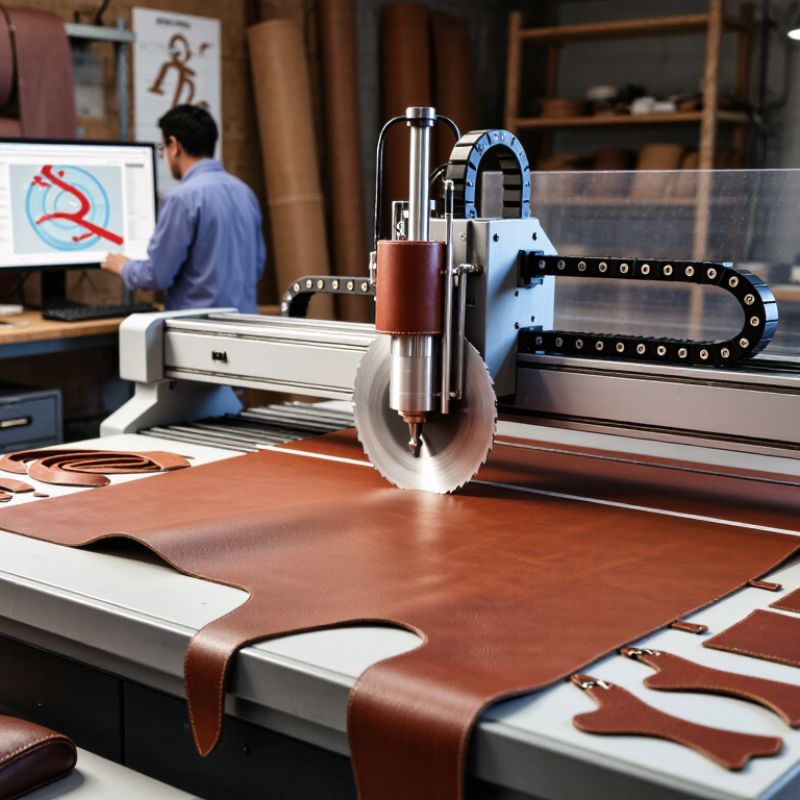
In industrial cutting, heavy-duty leather usually means hides measuring 2–6 mm thick. This range appears in work belts, protective covers, saddlery components, and rugged bags. Thickness alone does not define cutting difficulty. Dense grain, uneven moisture, and layered construction also affect blade performance. A CNC knife handles these variables with controlled pressure and programmed paths. It can follow repeated contours more consistently than manual cutting. On a busy floor, that consistency reduces material waste and operator fatigue. Still, no machine removes every production decision. Poorly prepared leather can shift, stretch, or leave rough edges.
For 2–6 mm leather, the cutting setup needs practical testing. Operators should match blade geometry, oscillation speed, feed rate, and hold-down pressure to the hide. A slow, stable pass often produces cleaner edges than excessive speed. Vacuum fixation helps prevent movement around small holes and tight curves. The digital file also matters; a tiny corner error can become a visible defect across hundreds of parts. CNC cutting improves repeatability, but it cannot correct inaccurate measurements or flawed patterns. That limitation deserves attention. I have seen a technically clean cut fail because the grain direction was ignored.
Tips: Test one sample from each leather batch. Inspect the underside for compression marks. Leave a small bridge between nested parts when movement is likely. Check edge quality under normal lighting, not only bright inspection lamps. Record settings that work, but question them when thickness or moisture changes.
Heavy-duty leather demands more than a sharp blade. It demands controlled movement, stable pressure, and repeatable positioning.
A CNC knife can maintain ±0.1 mm repeatability when the machine is properly calibrated and operated within its design limits. That figure means repeated cuts return to nearly the same location. It does not automatically guarantee ±0.1 mm absolute accuracy.
In practical testing, operators can cut the same belt panel several times and compare fixed reference points. Digital calipers, marked control lines, and documented settings make the result easier to verify.
The table must remain clean and level. Blade wear also matters. A fresh blade may follow a tight corner cleanly, while a worn edge can pull fibers and change the profile.
Small errors become visible around buckle holes and stitched edges.
Leather remains unpredictable. Thickness can change across one hide, and surface tension may distort a flexible part during cutting. That is where experience becomes important.
Skilled operators inspect the material, adjust vacuum or holding pressure, and record each adjustment. Even then, perfect repeatability is not guaranteed.
I would question any measurement taken without calibration records or sample variation data.
Reliable production comes from testing the machine, the blade, and the leather together. Accuracy should be measured, not assumed.
An oscillating blade can cut leather up to 6 mm thick with steady, programmable movement. This makes it useful for belts, saddlery panels, protective covers, and layered leather goods. The blade moves vertically at high speed, reducing the pulling action common with dull rotary tools. Clean edges matter.
In practical production, cutting performance depends on leather density, surface finish, moisture, and grain direction. A firm 6 mm hide may need slower feed speed and multiple passes. Thinner leather can often use a faster setting with less blade pressure. Experienced operators should test a small sample before cutting valuable material. I have found that a perfect digital file does not guarantee a perfect cut. Leather can stretch slightly, and that variation is easy to underestimate. Vacuum hold-down also helps prevent shifting around narrow corners and small holes.
Tips: Match the blade length to the leather thickness, but avoid excessive exposure. Check the edge after every test cut. If fibers remain attached, adjust speed, pressure, or oscillation gradually. Keep the cutting surface clean, because scraps can raise the material and change the depth. Use sharp tooling and follow the machine maker’s safety instructions. Avoid forcing a blade through dense layers. That usually creates rough edges.
CAD nesting makes material utilization measurable, not merely hopeful. In heavy-duty leather work, an 80–90% utilization target is practical for consistent hides, but not universal. Natural scars, holes, wrinkles, and uneven edges reduce usable area. Real leather is never a perfect rectangle.
WRAP’s cutting-room guidance reports that cutting layouts can create 10–20% material waste in manufacturing. The European Commission’s Best Available Techniques reference also identifies cutting optimization as a direct resource-efficiency measure.
These figures support a clear workflow: scan each hide, define defects, then let CAD nesting arrange patterns around them. Small improvements matter. On a 100-square-meter batch, raising utilization from 78% to 86% saves eight square meters.
A CNC knife follows the approved nesting file with repeatable pressure and speed. Operators can test blade depth on thick panels before production begins. This reduces crushed edges and incomplete cuts. However, software can still make poor decisions when defect mapping is inaccurate. That is the uncomfortable part. Measure twice.
Experienced teams usually separate hides by thickness, grain direction, and visual grade before nesting. They also reserve larger pieces for load-bearing components.
A 90% target may look impressive, yet weak grain placement can cause returns or premature failure. Material utilization must be judged beside strength, consistency, and inspection records.
For heavy-duty leather cutting, a CNC knife converts repeated manual work into a controlled production process. Digital patterns guide each cut with stable pressure and programmed speed. This reduces variation between operators, shifts, and production days. The machine can support near 24/7 automation when loading, inspection, and maintenance are planned carefully. It should not operate without supervision. Dust, uneven hides, or a worn blade can affect results.
The strongest advantage appears in consistent output quality. A calibrated system can reproduce panel dimensions, hole positions, and edge profiles across hundreds of pieces. Production teams can record cutting parameters and compare actual samples with approved patterns. This makes quality checks more objective. It also reduces material waste through accurate nesting. Small gains matter when each hide costs money.
Leather remains a natural material. Grain direction, scars, stretching, and thickness changes still require experienced judgment. Machines still make mistakes. A poorly prepared file can produce the same error all day. Skilled operators should test a first batch, inspect tight curves, and adjust blade depth when needed. In practical production, the best results come from combining automated repeatability with human review. A CNC knife is powerful, but it is not magic.
24/7 automation supports higher planned production capacity and more consistent cutting results than a conventional single-shift workflow.
The comparison uses a 168-hour weekly operating schedule for continuous production and a 40-hour schedule for a conventional single-shift process. The consistency index is normalized to show the relative stability of repeated CNC cutting paths; higher values indicate more consistent output.
It usually means leather between 2 and 6 mm thick. Common uses include belts, covers, saddlery parts, and rugged bags.
No. Grain density, moisture, stretching, scars, and layered construction also affect blade performance.
Yes, with suitable blade geometry, pressure, speed, and possible multiple passes. Dense leather may require slower movement.
Test one small sample first. Check the top surface, underside, edge, and material movement.
It helps keep leather flat around small holes and tight curves. Without fixation, edges may shift.
No. An inaccurate pattern can repeat the same defect across hundreds of parts. Machines need human review.
Use calibrated settings, accurate digital patterns, careful nesting, and regular sample inspections. Record useful settings, but question them later.
No. Operators should plan loading, inspection, cleaning, and maintenance. Dust and worn blades can change results quickly.
Adjust speed, pressure, or oscillation gradually. Check the blade and cutting surface first. Do not force it.
Natural leather varies. Grain direction, moisture, and stretching can defeat perfect-looking digital plans. The machine is capable, not magical.
Heavy-duty leather typically refers to hides around 2–6 mm thick, which require more power, control, and consistency than ordinary fabric cutting. A CNC knife provides a practical solution by combining programmed toolpaths with an oscillating blade designed to move cleanly through dense leather. With repeatability of approximately ±0.1 mm, it can produce accurate panels, seams, and shaped components while reducing variation between pieces. Understanding how to cut heavy-duty leather with a CNC knife helps manufacturers select suitable blade settings, cutting speeds, and pressure for materials up to 6 mm thick.
CAD nesting further improves the process by arranging patterns efficiently on each hide, potentially achieving 80–90% material utilization and reducing waste. Compared with manual production, CNC cutting supports continuous 24/7 automation, faster order handling, and stable quality across large production runs. This combination of precision, efficient material planning, and reliable operation makes CNC knife cutting well suited to demanding leather applications.

Deepit Cutter